Everest Group’s 2026 Payroll PEAK Matrix®: What It Means for Global Payroll Buyers
As global payroll becomes more complex, choosing the right partner requires looking beyond geographic coverage. Everest Group’s latest assessment provides an independent perspective on the providers helping enterprises navigate this complexity.
The challenge is no longer simply whether a provider can process payroll across countries. It is whether that provider can deliver consistent governance, local compliance, technology integration, and operational control across an increasingly complex global footprint.
The Everest Group Multi-country Payroll (MCP) Solutions PEAK Matrix® Assessment 2026 provides an independent perspective on how leading payroll providers are addressing these requirements. This year’s assessment evaluates 32 multi-country payroll providers across Global, Asia-Pacific (APAC), and Europe, Middle East, and Africa (EMEA) markets.
The 2026 Global Payroll Provider Landscape


Source: Everest Group, Multi-country Payroll (MCP) Solutions PEAK Matrix® Assessment 2026. Reproduced under license.
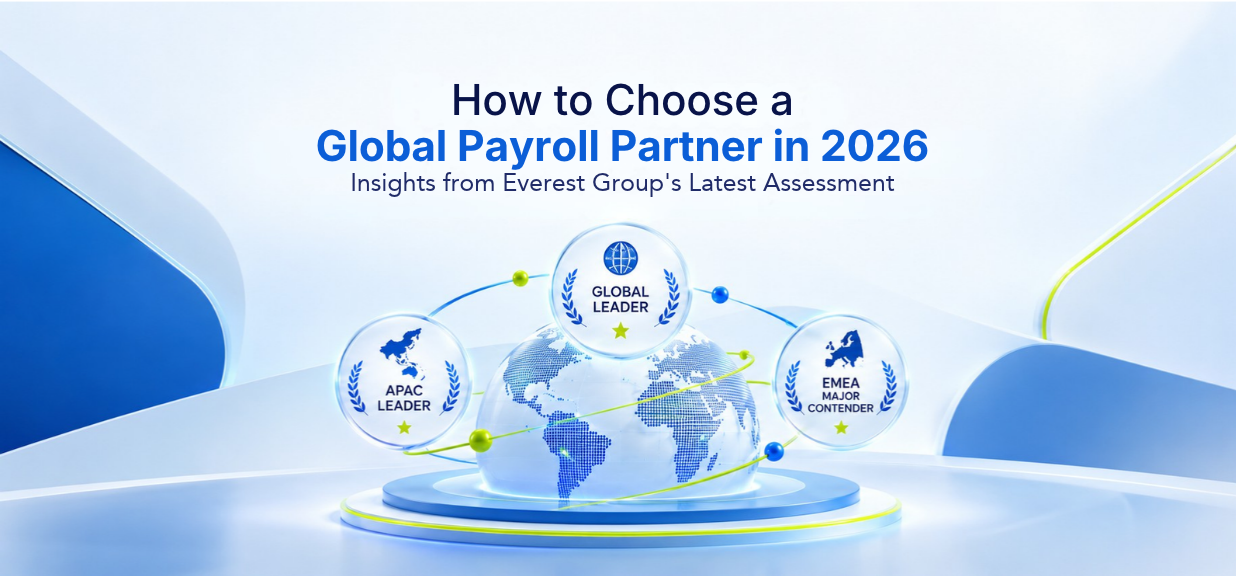
Neeyamo has been positioned as a Leader in the Global and APAC assessments and recognized as a Star Performer globally. It has also been positioned as a Major Contender in EMEA. The assessment highlights several strengths of Neeyamo; a few noteworthy observations are as follows:
- Native payroll technology: Operates 100+ proprietary native gross-to-net payroll engines.
- Expertise in complex and long-tail markets: Supports diverse industries with geographically dispersed payroll operations.
- Enterprise integration capabilities: HCM integration ecosystem across certified providers and partnerships to strengthen HRO-led payroll transformation.
- AI-driven payroll intelligence: Payroll I.O and its expanding AI capabilities. Neeyamo invests in improving payroll accuracy and efficiency.
Understanding the 2026 Global Payroll PEAK Matrix®
For multinational enterprises evaluating their payroll strategies, the assessment offers valuable insights into the capabilities that matter when selecting a global payroll partner. Everest Group evaluates payroll providers based on two principal dimensions:
Market Impact: The provider’s demonstrated success in the market, including market adoption, portfolio mix, and value delivered to clients.
Vision and Capability: The provider’s ability to deliver services successfully, including its vision, technology investments, service capabilities, geographic coverage, and delivery model.
Providers are classified as Leaders, Major Contenders, or Aspirants. The assessment also recognizes Star Performers, identifying providers that demonstrate significant year-over-year improvement.
The assessment provides a comparative view of the global payroll provider landscape. For buyers, however, the most important question is not simply where a provider appears on the matrix.
It is what that positioning means for the enterprise’s specific payroll requirements.
Five Questions Global Payroll Buyers Should Ask
Payroll providers serve different segments, but the fundamental questions remain centered around the following 5 questions:
1. Can the provider manage complexity beyond major payroll markets?
Most multinational enterprises operate across a mix of large, established markets and smaller, more complex jurisdictions. The latter frequently create disproportionate operational challenges. Local statutory requirements, changing regulations, language differences, banking infrastructure, and limited payroll volumes can make these markets difficult to manage efficiently.
What buyers should evaluate:
- Does the provider have established local statutory expertise?
- How much of the payroll process is delivered through its own technology and operating model?
- Where does it depend on third-party aggregators or local vendors?
- Can it demonstrate consistent controls and service quality across high-volume and long-tail markets?
Why this matters: A global payroll solution is only as dependable as its ability to handle the jurisdictions where complexity is greatest. This is an area in which Neeyamo has made sustained investments, building its global payroll capabilities around the requirements of complex and long-tail markets rather than treating them as extensions of larger payroll operations.
2. Does global payroll mean one operating model or multiple disconnected providers?
A consolidated commercial contract does not necessarily translate into a consolidated payroll operation. Enterprises may still face fragmented workflows, inconsistent reporting, multiple technology environments, and varying levels of control across countries. This creates additional work for payroll, HR, finance, and compliance teams.
What buyers should evaluate:
- Can payroll operations be managed through a unified platform?
- Are processes and controls consistent across countries?
- Is there centralized visibility into payroll status, exceptions, and compliance?
- How are local payroll requirements accommodated without fragmenting the global operating model?
Why this matters: The objective of payroll consolidation should be operational simplification, not merely vendor consolidation. Neeyamo’s approach combines global payroll technology with localized execution capabilities, enabling enterprises to maintain centralized oversight while addressing country-specific requirements.
3. Can payroll intelligence translate into action?
The opportunity is to move from simply reporting payroll information to using it to improve decisions and operational outcomes.
What buyers should evaluate:
- Can the platform identify exceptions and potential compliance issues?
- Does it provide actionable insights rather than just dashboards?
- Can those insights be translated into workflows and corrective actions?
- How does AI support accuracy, productivity, and operational decision-making?
Why this matters: Intelligence creates value when it helps organizations prevent errors, resolve exceptions, and improve payroll outcomes. Neeyamo’s technology investments, including ARIA and Compass, reflect this direction: connecting payroll intelligence with operational execution.
4. Can the provider integrate payroll into the enterprise technology ecosystem?
Global payroll cannot operate in isolation. It must connect with HCM systems, HR platforms, financial applications, and enterprise workflows. Weak integrations create manual work, inconsistent data, reconciliation challenges, and additional operational risk.
What buyers should evaluate:
- How effectively does the provider integrate with the enterprise’s existing HCM environment?
- Are integrations standardized, supported, and maintained?
- Can employee and payroll data move consistently across systems?
- Does the integration architecture support future geographic expansion?
Why this matters: Payroll integration should reduce complexity across the enterprise rather than introduce another disconnected technology layer. Neeyamo continues to invest in enterprise HCM connectivity and integrations to support more seamless global payroll operations.
5. Can the provider support the enterprise as its global footprint evolves?
Organizations enter new markets, restructure operations, acquire businesses, change technology platforms, and respond to evolving regulations. A global payroll partner must be able to accommodate these changes without requiring enterprises to repeatedly redesign their payroll operating models.
What buyers should evaluate:
- How quickly can new countries be incorporated?
- Can the provider accommodate different employment and operating structures?
- How does it maintain regulatory readiness?
- Can the solution scale without compromising visibility, controls, or employee experience?
Why this matters: Global payroll should be an enabler of international growth, not a constraint on it.
Choosing a Global Payroll Partner: Beyond the Matrix
Independent analyst assessments provide an important starting point for enterprise evaluation. They offer structured comparisons, market perspectives, and an understanding of provider capabilities. But the final decision should be grounded in an enterprise’s own operating requirements.
A provider that is well suited to a multinational with substantial payroll volumes in a handful of established markets may not necessarily be the best fit for an organization operating across dozens of complex jurisdictions. Similarly, a company prioritizing technology consolidation may evaluate providers differently from one focused on compliance remediation or international expansion.
The most effective selection process combines independent analyst research with practical evaluation of:
- Geographic requirements and local payroll complexity.
- Technology architecture and enterprise integrations.
- Compliance capabilities and operating controls.
- Implementation and ongoing service delivery.
- Ability to support future business requirements.
The Future of Global Payroll Is Connected, Intelligent, and Locally Grounded
As multinational organizations seek greater control over their global payroll operations, the expectations placed on providers will continue to rise. Technology must simplify complexity rather than conceal it. AI must contribute to operational outcomes rather than merely generate insights, and global delivery must be supported by the local knowledge required to manage statutory obligations accurately and consistently.
Everest Group’s 2026 assessment provides enterprises with an independent perspective on the providers operating in this evolving landscape.
For Neeyamo, its Leader positioning reinforces a long-standing conviction: the most effective global payroll solutions combine global consistency with local precision. That is the foundation on which Neeyamo continues to build. To get in touch with us, write to us at irene.jones@neeyamo.com
Everest Group and PEAK Matrix® are trademarks of Everest Global, Inc. Everest Group does not endorse any provider, product, or service through its research.